


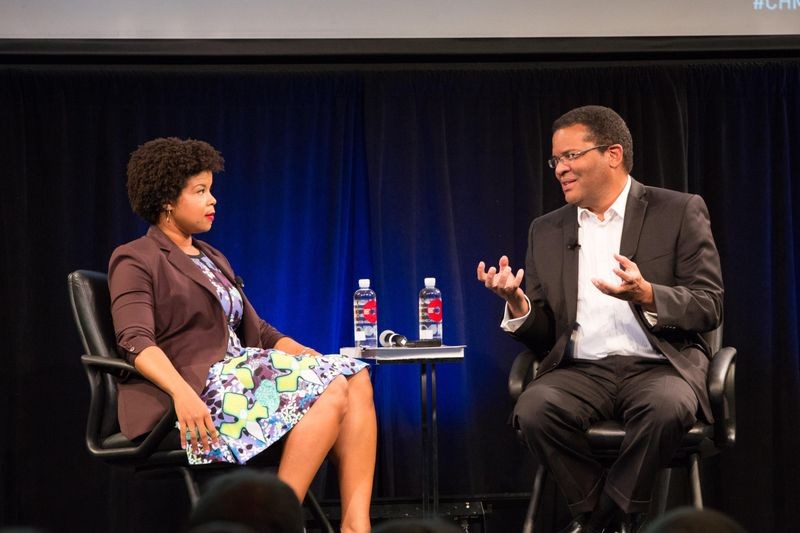
鈥淭echnology, Health & Equality: California Endowment SVP Dr. Anthony Iton in Conversation with P2Health Ventures Co-Founder Vanessa Mason,鈥� August 24, 2017. Produced by 91自拍 Live.
In an age of sophisticated healthcare technologies and research tools, the doctors you see or hospitals you visit are only a small part of what determines your health. Through extensive research and data analysis, one doctor discovered a tie between your zip code and your health.
Your zip code may affect your health more than your genetic code. This video highlights just how healthcare inequality can impact an entire country.
Dr. Anthony Iton described the path to this discovery as 鈥渟ort of a technological story鈥� in a conversation with P2Health Ventures Co-Founder at a 91自拍 Live event on August 24, 2017. Iton said he first witnessed the link between health and socio-economic status as a Johns Hopkins medical student working in East Baltimore at the height of the crack and AIDS epidemics. 鈥淲hen I got to East Baltimore and I saw the conditions, I was really quite shocked,鈥� Iton said. 鈥淚t sort of triggered this thinking in my head that in the US, does where you live ultimately shape your health more than any of your genetic factors?鈥�
Dr. Anthony Iton shares how his time as a medical student in East Baltimore inspired him to study healthcare inequality. He used technology to map how lifespans vary based on zip codes throughout the US.
This connection became more clear in his role as the director of the Public Health Department for Alameda County. As the person responsible for signing the county鈥檚 thousands of death certificates, Dr. Iton started to notice patterns in the ages, causes of death, ethnicities, and zip codes of the deceased. 鈥淚 got really excited at the technological possibilities of using these death certificates to start painting a picture of the distribution of death across Alameda County,鈥� Iton said. Using geographical information systems (GIS) to map the data across Alameda County census tracks, he started to identify disparities in life expectancy neighborhood by neighborhood.
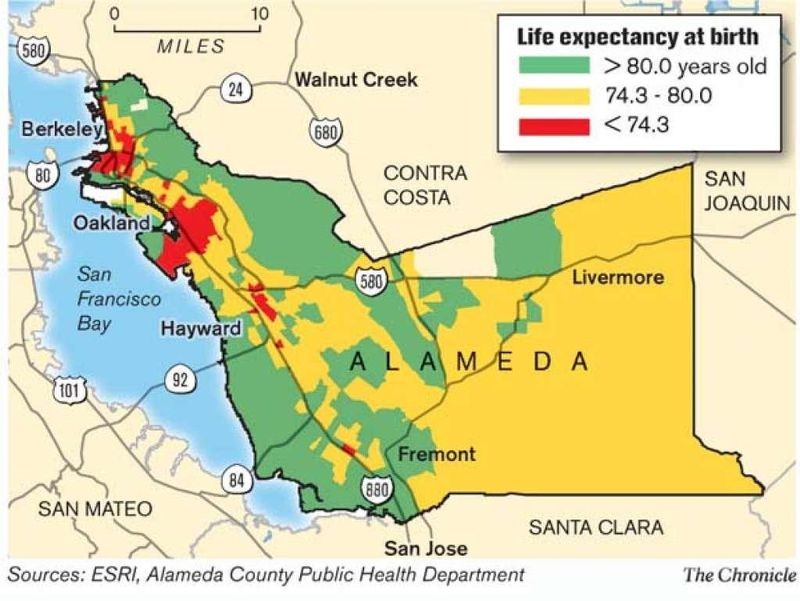
It didn鈥檛 take long before he started to replicate his GIS analysis to Baltimore, then to Seattle, Boston, Minneapolis, and cities across the US. The findings were the same鈥攖here could be as much as a 25-year difference in life expectancy between neighborhoods 1.5 miles away from each other. 鈥淲e haven鈥檛 found a city in the United States yet that doesn鈥檛 have a significant life expectancy difference from neighborhood to neighborhood. This is the American pattern,鈥� Iton said. 鈥淏efore you had the technological ability to sort of bore down into neighborhoods and use large data sets to [. . .] discern these patterns, we didn鈥檛 really understand this.鈥�
So why does your neighborhood have such a dramatic affect on your health? 鈥淧eople in [. . .] low-income communities are facing inexorable stress. Basically, every system that they are trying to engage is failing them鈥攖ransportation, housing, employment, criminal justice, even water in some instances,鈥� Iton said. 鈥淲hat that does is [. . .] it creates chronic stress. And that changes your physiology and changes your genetic expression and over time, it mimics premature aging.鈥�
In his research on the connection behind your zip code and your health, Dr. Anthony Iton discovered that poverty contributes to chronic stress, which can change a patient鈥檚 physiology and cause disease.
As a health tech investor, moderator Vanessa Mason explained how technologists and entrepreneurs may need to shift their thinking in this area to help address health inequities. 鈥淗ealthcare is not actually the same thing as health. [. . .] When we look at media or read about it, I think these two things often get conflated but they are in fact two completely different things,鈥� Mason said. 鈥淚n thinking about a fund and the startups we鈥檙e investing in, we are interested in addressing these issues and how can we alleviate those sources of stress.鈥�
Dr. Iton explained how the current healthcare system is failing to address conditions like stress. 鈥淭he notion that experts hold the answers is a flawed notion,鈥� Iton said. 鈥淥ur healthcare system is still a 19th-century system design where you go to an expert and that expert gives you a drug and solves your problem. The 21st-century problems are heart disease, cancer, stroke, chronic lower respiratory disease, which are chronic diseases, which are more related to the environments and the lifestyles which people are living.鈥�
California Endowment SVP Dr. Anthony Iton discusses how technology can catalyze civic engagement in struggling communities鈥攁nd the impact that having agency can have on a person鈥檚 health.
However, Dr. Iton says healthcare institutions are starting to study the social determinants of a patient鈥檚 health, including factors like housing, transportation and access to healthy food. An example of this is , which takes information about a patient鈥檚 basic resource needs and adds it to his or her medical record. The organization then helps connect the patient to community organizations that can assist them. 鈥淭he next step beyond that is to start to aggregate this data and use it in the policy space to push for policies that will further the access at a community level to these kinds of resources,鈥� Iton said.
Patients and communities can also play a role in championing their own health by contributing to local and national policy discussions鈥攁nd technology can enable that. Dr. Iton has seen this firsthand in his current role as the senior vice president of the California Endowment鈥檚 , where he is focused on improving health conditions in 14 low-income communities throughout California. 鈥淲hen you see communities that are suffering from poor health, typically they feel like they have very little control. So how can technology optimize democracy? Iton said.鈥滻 think those are the big challenges for us.鈥�
California Endowment SVP Dr. Anthony Iton discusses why our current healthcare system is flawed鈥攁nd how communities can mobilize to address the external factors affecting their health.
The 91自拍 Live team caught up with Dr. Iton and Vanessa Mason backstage to chat firsts and favorites. Here鈥檚 what they shared.
91自拍 Live: What鈥檚 a project or activity outside of work that you鈥檙e currently passionate about?
Vanessa Mason: I鈥檓 really excited about my new program for 9-5ers turning their side project into a side venture while maintaining work-life balance called Healthy Hustle Habits. It鈥檚 based on a lot of the education I have about behavioral science and social psychology as well as my experience both recovering from burnout and balancing a full time job and side ventures that I was super excited to scale. I鈥檓 finally formalizing a lot of the techniques that have helped me to be successful and looking forward to sharing that with part-time entrepreneurs.
91自拍 Live: What鈥檚 the best part of your job?
Anthony Iton: The best part of my job is visiting with community residents in our 14 Building Healthy Communities sites. When I am with community residents who are fighting for improvements in their neighborhoods or policy changes for their children and families, I feel like I am in church. It is a spiritual high.
91自拍 Live: If you could book a flight to anywhere in the world tomorrow, where would you go and why?
Vanessa Mason: I would make a beeline to the Maldives. I鈥檝e been obsessed with staying in a glass bottomed cabin where I can jump right into the sparkling waters of the Indian Ocean. The island nation looks gorgeous and after going to the Seychelles last year and living in Mozambique, I鈥檓 convinced that the Indian Ocean is the most beautiful ocean.
91自拍 Live: Which current moonshot/tech project would you most like to happen?
Anthony Iton: Mega storage batteries for home use that will allow people to get completely off the grid and power all of their needs from solar photovoltaic cells. That is my life goal. Zero carbon emmissions.
91自拍 Live: What鈥檚 on your playlist?
Vanessa Mason: It鈥檚 funny that I鈥檝e reached an age where I鈥檓 nostalgic for the music of my childhood. For me, that鈥檚 鈥�90s pop/R&B: Whitney Houston, Mariah Carey, Janet Jackson, Michael Jackson, etc. My parents also felt the same way about the music of their youth so I know the lyrics to a ton of 鈥�70s soul icons like Stevie Wonder, Aretha Franklin, and Diana Ross. I鈥檝e also lived in Argentina and Brazil so my playlist is peppered with Brazilian samba and Tropicalia, salsa (Celia Cruz is a fave), Latin pop from Selena to Shakira, and merengue because I grew up in Texas listening to Elvis Crespo. I also love to dance and take dance classes semi-regularly so there鈥檚 a fair amount of reggaeton, soca and Afrobeat as well.
91自拍 Live: What鈥檚 a project or activity outside of work that you鈥檙e currently passionate about?
Anthony Iton: Building a rabbit hutch for my 8-year-old daughter in our backyard.