


At Westwood Elementary in Santa Clara, California, in room 17, there was an Apple II computer, and at recess, if you鈥檇 earned enough classroom points, you could play one of a dozen or so games. They were the standards found in every classroom in 1983.
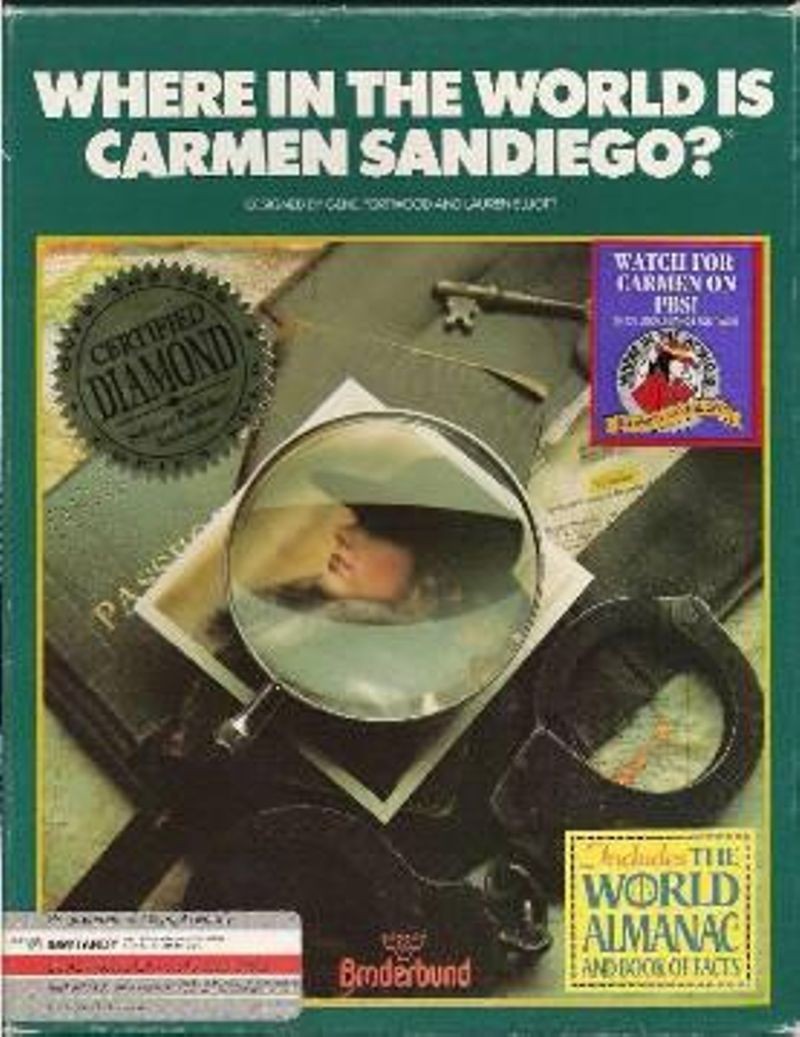
The original Where in the World is Carmen Sandiego?
These were typical, played by millions of kids in schools around the world. I somehow managed to earn the points necessary to get a lunch period with the machine, and I begged a friend to bring in a special game for us to play that day. She brought it in, but hid it in her backpack in case our teacher might have objected. It was a game I had never played, but one which every other kid in the class who had their own computer raved about.
The game was Where in the World is Carmen Sandiego?
There was an explosion of educational software for the Apple II in the late 1970s and early 80s. Apple gave so many schools Apple IIs that a large market for classroom-based software evolved. One of the biggest software developers for the Apple II platform was 叠谤酶诲别谤产耻苍诲 Software. While best known for such practical programs as Print Shop and Mavis Beacon Teaches Typing, they also released several games, including Galactic Empire, Apple Panic and Choplifter. While 叠谤酶诲别谤产耻苍诲 seemed to focus on the Apple II, they also released games for the Commodore 64, MS- DOS computers, and even the Nintendo Entertainment System. Many of these games became exceptionally popular, and many were frequently copied and shared.
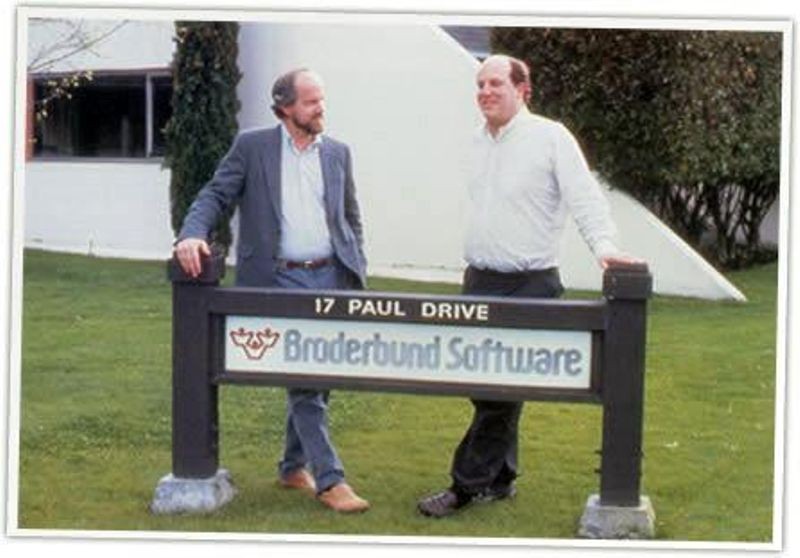
叠谤酶诲别谤产耻苍诲 Co-founder Gary Carlston with Marc Canter from Macromind at 叠谤酶诲别谤产耻苍诲 Headquarters
In 1983, 叠谤酶诲别谤产耻苍诲 co-founder Gary Carlston conceived of a game that could be used to teach kids about geography. Carlston pitched the idea to Dane Bigham, one of 叠谤酶诲别谤产耻苍诲鈥檚 programmers, who had an adventure game in development. Using the interface for that game as the 鈥渓ook and feel鈥�, Bigham handed off the rest of development to 叠谤酶诲别谤产耻苍诲鈥檚 creative department, known as the 鈥楻ubber Room鈥�, headed by Gene Portwood and Lauren Elliott. Initially, Portwood and Elliott developed the game 鈥淪ix Crowns of Henry VIII鈥� in which players chased the Tudor King around London. David Siefkin began working on the project and wrote an early version of the script while poolside at University of California鈥檚 Strawberry Canyon. Taking inspiration from Colossal Cave Adventure, Siefkin transported Adventure鈥榮 search for underground treasure into a map of the world, though he would leave the company before the game was finished, ironically to become a diplomat.
The game settled on a spy theme with the player becoming an agent of INTERPOL chasing various baddies from the Villains鈥� International League of Evil, or V.I.L.E., around the world. As the player gained clues from investigating, they eliminated suspects until they could finally get a warrant to arrest the criminal, all before a week had passed. The agents would fly from city to city around the world, obtaining clues that had to be interpreted through the use of a World Almanac, included with the game. Much like the 鈥榝eelies鈥� included with Infocom鈥檚 text-based adventure games, the Almanac served as a low-tech form of copy-protection: the user had to use it to solve the clues. A clue might be 鈥淭he person you鈥檙e looking for was here, and he wanted to study Saxon manuscripts. He said he didn鈥檛 like seafood.鈥� From that, a check of the World Almanac would let you know about the Saxons, then you鈥檇 inspect what cities the criminal might have flown to, from where you were, or you could visit the Crime Lab and use your new knowledge about the crook to try to gain the warrant.
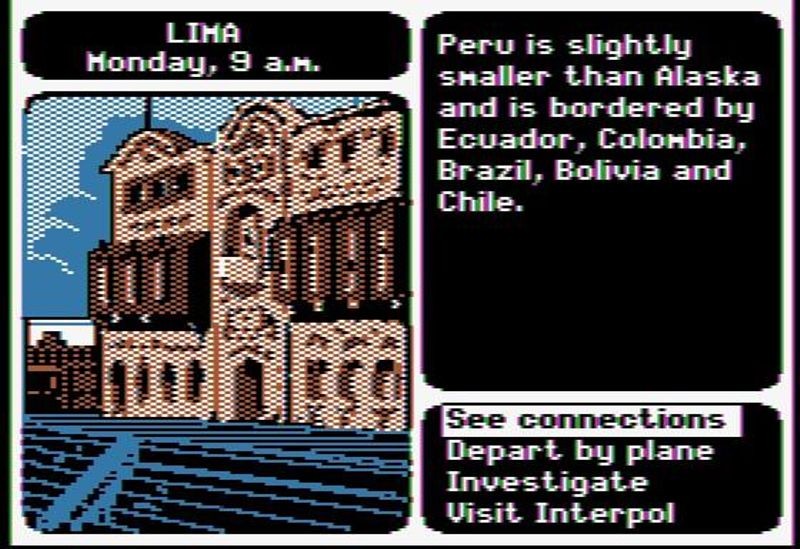
Screenshot from Where in the World is Carmen Sandiego?
Part of the fun was the humor blended into the game. Puns were a big part of it, especially in the names of the various V.I.L.E. operatives: Justin Case, Sarah Nade and Patty Larceny, for example. These names were often humorous, though when I was a kid, I didn鈥檛 quite know that. The graphics, especially of V.I.L.E. henchmen, were cute, and the images of each of the cities you鈥檇 visit were simple, but illustrative of what a tourist might find on the cover of a travel brochure. You鈥檇 chase the crooks until you arrived at a city where you鈥檇 have a knife fly across the screen, or a gunshot ring out. That would be your indication that you had the right city, and if you had your warrant, you could arrest the perp!
As the various criminals were captured, the Agent gained higher ranks in INTERPOL and came ever closer to tangling with V.I.L.E.鈥檚 enigmatic leader: Carmen Sandiego. Carmen, always in her red trench coat and eye-shading red hat, was presented as a former INTERPOL agent who had turned to crime after finding it too easy to capture crooks. The fact that Carmen (never referred to as Sandiego!) was a woman can be seen as rather startling. She鈥檚 the head of an international criminal organization and was not presented as so many female heroes of computers games have been. She was covered in a trench coat, her face obscured by the hat, a far cry from the sexualization many female characters in games are tagged with. She was also a Latina, even voiced by the great Rita Moreno in the cartoon series Where on Earth is Carmen Sandiego?
The game is usually identified as a type of 鈥渆dutainment鈥� game. Such games are designed to be educational, while using the entertainment elements found in most games. Comparing Where in the World is Carmen Sandiego? to a game like Lemonade Stand shows the difference between a purely educational game and an edutainment style game. While there can be a lot of fun playing Lemonade Stand, it鈥檚 obvious from the beginning that it鈥檚 only real goal is to educate students. The focus on the entertainment qualities of Where in the World is Carmen Sandiego? goes much deeper, with the storyline being a prominent element, along with amusing characters, and most importantly, high-end sound and graphics for the time. These combined to make Where in the World is Carmen Sandiego? a game that could become popular both at home and in classrooms, and it grew into a franchise that went beyond just games.

The Chief (Lynne Thigpen) with a World Atlas: one of the prizes from the PBS game show Where in the World is Carmen Sandiego?
In 1991, PBS began running the game show Where in the World is Carmen Sandiego? in response to a National Geographic survey that showed many Americans had little knowledge of geography. The show featured Tony award-winning actress Lynne Thigpen as The Chief, the head of ACME, and was hosted by Greg Lee. Perhaps the most memorable part of the show was the music performed by the a capella group Rockapella. The theme song, composed by Sean Altman and David Yazbek, is particularly memorable. Over the five seasons it was on the air, the program won several Daytime Emmys and a Peabody Award. This was followed by other Carmen Sandiego-themed television programs, both games shows like Where in Time is Carmen Sandiego?, and an Emmy-winning Saturday morning cartoon.
Following the success of Where in the World is Carmen Sandiego?, 叠谤酶诲别谤产耻苍诲 released many sequels and related titles in the series. Starting with Where in the USA is Carmen Sandiego?, 叠谤酶诲别谤产耻苍诲 released more than a dozen offshoots. Many were geography-related, but others taught history, space science, math, and language concepts within the Carmen Sandiego universe. In some, it鈥檚 merely the setting that changes and the game remains much the same as the original. Others, like Carmen Sandiego Word Detective, use the settings, concept, and characters, but entirely different forms of game play.
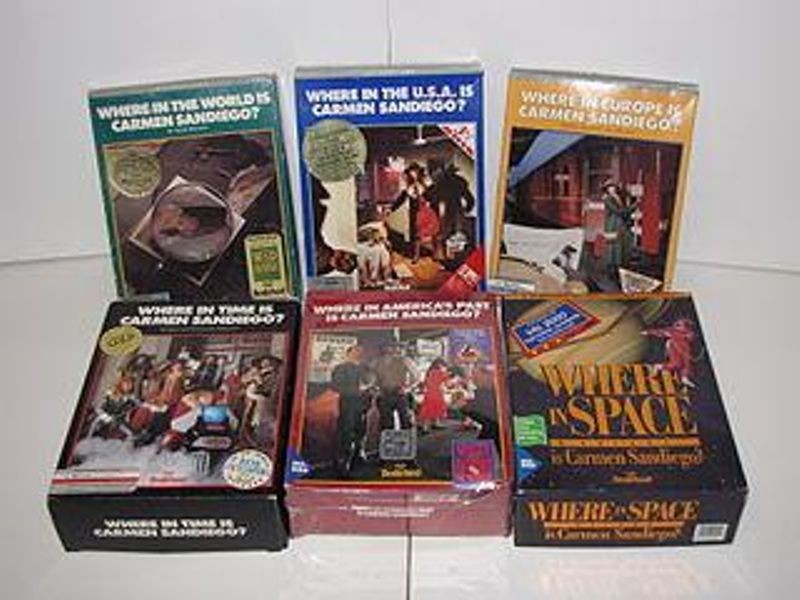
Several of the sequels to Where in the World is Carmen Sandiego?
Very few computer gaming franchises have had the success and diversity of the Carmen Sandiego series. When we were playing on that Apple II in fourth grade, we didn鈥檛 really recognize that we were learning geography, or interacting with a positive female role-model, or discovering research skills. No, all we knew was that Carmen and the rest of the V.I.L.E. gang were on the run and it was our job to catch 鈥榚m!