


SpaceWar! the granddaddy of computer games, debuted in 1962.
Since then games have evolved, both in the technology they use and in the role they play in the lives of people of all generations. New game sales surpass many other entertainment media and get press coverage to match. Games are as likely to be played on a SmartPhone or through Facebook as on a dedicated game console.
But in 1987, after the first quarter of a century of wild successes and dramatic downturns, the game industry was at a turning point. We were seeing the beginning of the PC-based software explosion just as the third wave of game consoles was re-invigorating the industry after the famed “Crash of 1983.”
In November 1987 The Computer Museum in Boston held a “Computer Games Weekend” to celebrate the twenty-fifth anniversary of SpaceWar! There were demonstrations of an original Digital Equipment Corporation PDP-1 playing the game, a Micromouse robot demonstration, a Core Wars tournament, and of course a SpaceWar! birthday party.
There was also a speaker panel on the history and the future of computer games that included several of the leading lights in the field:
In the next 25 years games expanded far beyond what these five legends could have guessed in 1987. Explosions in processing power, graphics capabilities, and networking changed gaming and added levels of realism and characterization that would have astounded them. Their ideas about interactive fiction and multi-player games did come true in today’s massively multi-player online games like World of Warcraft. While some of the forms of gaming they discussed are largely gone now, like text-based adventures, other forms they hinted at have grown into entire new fields of gaming that generate billions of dollars in sales and entertain millions of users around the world.
We are all aware of the general view of computer games as mindless spinal recreations involving nothing higher than the cerebellum, that little mass of gray matter above your neck that helps you to play the piano, tennis and also to shoot hostile aliens. There are some who understand that there’s a lot more to some computer games than that. I would say the intellectual content of games bears watching. A key question is: what is going to happen to that intellectual content in general? Will these games become more demanding at the cerebral level than at the cerebellar?
Sometimes to be educational, a computer game gives up recreational content. At the same time, it almost seems that the more recreational a game, the lower a common denominator it demands. Another important theme is the single player versus the multi-player issue. I submit that there are no four people more competent to describe the current place of computer games and their future prospects than the four game designers on this panel.
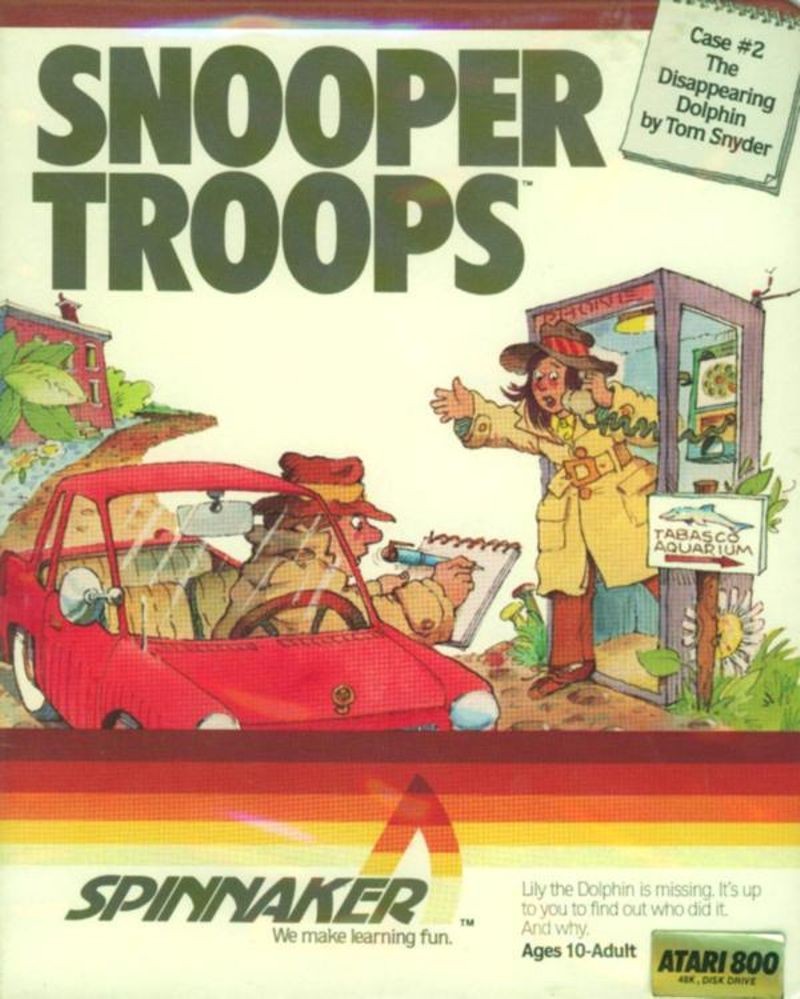
Tom Snyder Productions’ Snooper Troops, one of the most successful educational software series of the 1980s.
In 1962, I was introduced to nerddom. I found a book on computer relay circuitry written by Bell Telephone. And I designed a couple of binary coded decimal computers. I thought I had invented digital electronics. My father told me I ought to send my paper plans to IBM, which I did. I was twelve at the time and I knew it was cute, not important. 91×ÔÅÄ a month later, when I came home from school, there was at least $10,000 worth of computer equipment on my front lawn with a note from the president of IBM saying ‘Remember us when you get older’ (joke)
I proceeded to go off the deep end at that point and told my parents that I’d like to make this computer I designed because I had the parts to do it. So all I did was computers because they were the one think I could control in my life. When I was sixteen I gave them up because I had basically no social skills and found I couldn’t get along with people. Since then, I’ve had a healthy respect for how uncool computers are for adolescents.
This generation of computer owners doesn’t feel comfortable about owning their computers. It’s a bit of a sin. It’s something we hide in our back rooms. We don’t let our families in on it – there are a few inside friends we might tell. ‘Yeah, I got a computer, but it’s back in my office.’ But you don’t bring them all back there and say ‘Hey, we got this great game, why don’t we all play it?’ You know, it’s not part of our social acceptability somehow. That’s one of our problems.
I want to reach some level of success that says that now we’re communicating with people other than news like ourselves.
At a baseball game you do two things – talk about what’s going to happen and go to the bathroom. But it’s great. There’s something extremely social about these sports – it’s the talking about it.
Intellivision’s two biggest games were baseball and football. I had the problem of finding someone to play with – I mean grown men don’t invite each other over to do trivial things.
Dan Bunten did one of the few four-people games. There were quite a few two-people computer games out there but Dan really pushed the limit. Four people is better than two – that’s a real great party. There’s a lot of talking, kidding and social context, a lot of self-handicapping. People learn some rules about society when they’re playing games. You don’t learn rules about society playing with yourself.
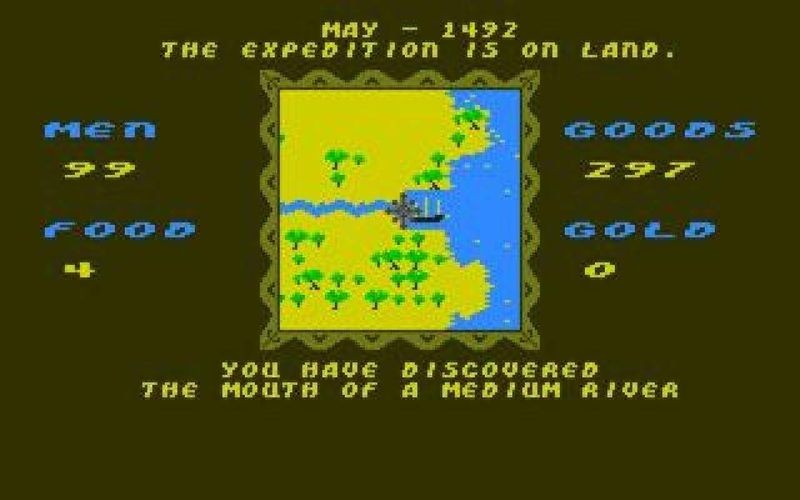
Ozark Software’s Seven Cities of Gold – Designed by Dan Bunten.
Go back to what games were about. They’re about people interacting with each other. They’re about having fun with your friends. I have to say we’re having trouble with that one, but I’m willing to keep punching out in that direction.
We’re forced – if we’re playing a computer game – to look at a screen, which forces us to look from each other. A lot of the fun in a socially involving game is looking at each other, talking to each other over the game. If the computer gets too good at being the focus of attention, then we’ve lost what we came here for.
What Dan said is true. The fun is not so much in planet the game but in the social interaction of four people playing the game. The fact that they have to sit there staring at the screen is really a drawback. I agree that multi-player games are really important; I’m not so certain that the technology is there to make them a big market yet, but I’m hoping that the things that will push it along – the way “Lotus 1-2-3″ did for personal computers – will come about. At some future date, I think multi-player games will exist and be very good.
I think we’re working in a pulp medium and we are working for what is in effect a pulp audience.
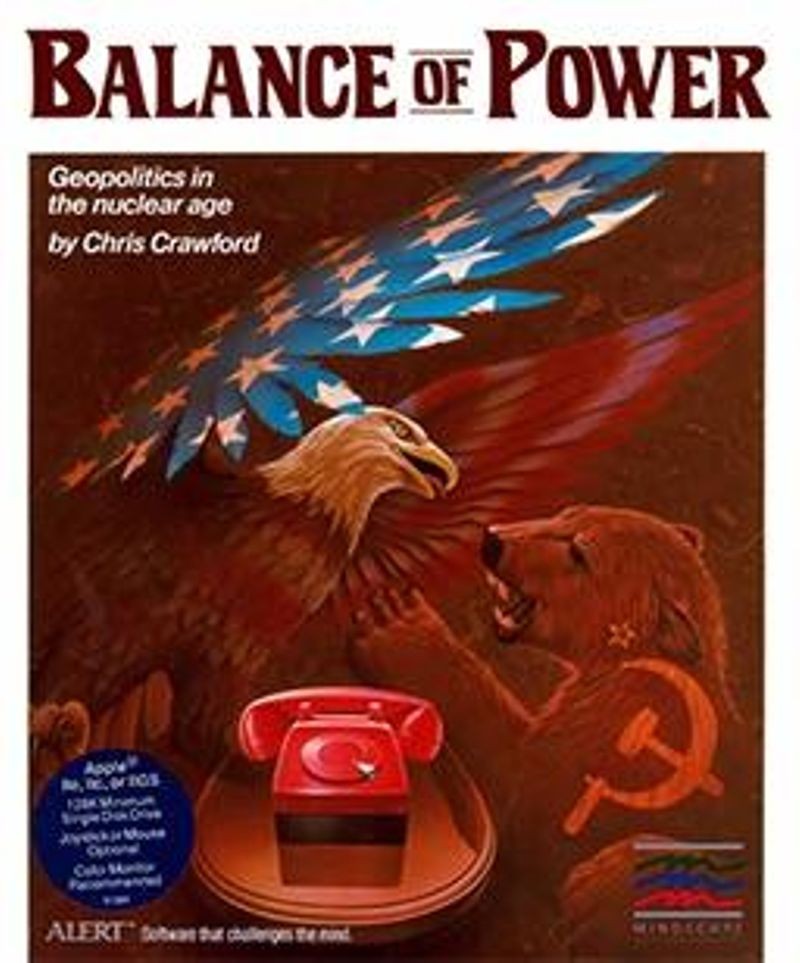
Balance of Power, designed by Chris Crawford, explores Cold War brinksmanship, allow the player to become either President of the United States or Secretary General of the Communist Party of the USSR.
All other artistic media are fundamentally non-interactive. Basically what you do with every art form is sit on your butt and absorb it. So we play wonderful music and what do you do? Sit back and listen. We paint a beautiful painting and you look at it. We write a great book and you read the book. But what do you actually do in all this? Nothing. You’re passive. And that’s a fundamental failure because the human mind is not a passive receptacle. You don’t just open up the top of the skull and pour stuff in. The human mind works best when it gets to take the butterfly and tear the wings off it and play with it and interact with it. That’s an absolutely fundamental part of the way our brains work. Yet art has completely failed to recognize that. Why? Well, we didn’t have the technology to do it… until today. Now we have the technology to deliver an artistic experience
You can move technology forward on a timescale of months or years, but art? Art takes wisdom, and that takes a long time – decades or centuries.
Artificial personality is an artistic medium or regime dedicated to the capture of human nature through the medium of the algorithm. Now that may strike you as a little sick. Algorithms are cold mathematical equations. Somehow I’m going to try and express human personality through a cold medium like an algorithm? That may sound sick to you, but let me remind you that stone is cold. Look what somebody did with it when they made a statue called The Pieta. What about cat gut? Let’s take the insides of a cat, but him open and stretch out his insides. What are we going to do with that? We’re going to play Beethoven’s violin concerto.
The technologies of art are cold because they are things. It’s what the artist does with the technology that breathes life and warmth into it. There’s nothing intrinsically cold about algorithms. It’s how much art you bring to them. The fact that so far algorithms have been exclusively in the hands of scientists and programmers is only an indication of how little artistic effort we’ve made so far.
Movies, books, records have common elements: love, sex, greed, sorrow, happiness, plot development, character development, people caring about each other, people getting angry, people killing themselves, people killing because they’re in love.
We can’t engage people by making better landing gear. At some level the vast majority of the human race cares about other people more than they care about things. To me, one of the best ways to let them manifest that care in relation to computer games is to make computer games that let people interact with each other and not with emulated, imagined or supposed characters inside a computer, no matter how good they are.
We may think that if we get a great new resolution or great sound shifts, we’re going to suddenly have people saying ‘Hey, this is just like TV.’ Well, so what? TV’s already here – we don’t need something like TV.
Interactive fiction is one of the hottest concepts of the ’80s. It’s also one of the most problematic entertainment forms of the ’80s. That isn’t to say we shouldn’t develop it. Most entertainment software is missing some incredibly important element that entertainment is all about, some kind of identification and caring about the character.
The single thing I identify as our biggest failure is not putting any characters into our games. That won’t solve our problems, but we haven’t even reached square one until we have characters. Imagine movies without characters in them. Imagine literature with no characters. There with no actors. Take the movie “Star Wars,” and take out Darth Vader, Luke Skywalker, Han Solo, Princess Leia, R2D2, C3PO, Obi Wan Kenobi, and what do you have lift? ‘Da daa da da da daa daaa, zap zap boom. Ok, Roll the credits…’ that’s what you’ve got – nothing.
We really don’t have any characters in our computer games. The characters we do have are fake. The best character I’ve seen in any computer game is Floyd, the robot from ‘Planetfall.’ Floyd is a cute guy who does funny things and then dies. But you see, if you walk up to Floyd and says ‘Floyd, I hate your stinking guts,’ well, then Floyd is still a cute guy who does funny things and then dies. Because you see, Floyd isn’t real. He’s a fake. He doesn’t have any personality. He doesn’t feel anything. He doesn’t even know you exist. He is a Potemkin Village. And he’s the best we’ve got. In all of computer gamed, we don’t have a single character as rich, as subtle, as complex as Gilligan from “Gilligan’s Island.” We have yet to climb up to the level of television. It will be an artistic milestone when we get a game as good as the “A-Team” or “Dukes of Hazzard.” So, we’re in a terrible situation right now.
I say characters are what we care about. When we watched “Star Wars,” we didn’t care about the spaceship or about the zapping and all of that; what we cared about was the people. We need to put people into our games.
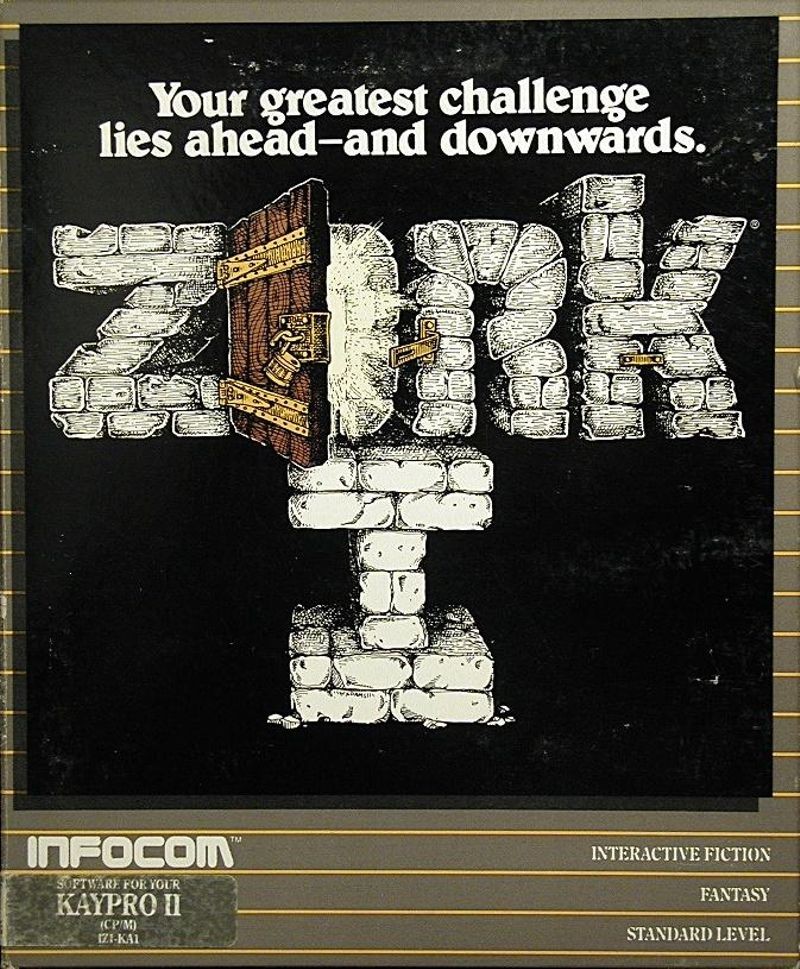
Zork was initially designed for the PDP-10, then split into three games and sold as three separate games by Infocom.
I really want to see games where I sit down and say, ‘Floyd, let’s not play hucka bucks beanstalk. Let’s read Tolstoy,’ and Floyd says ‘Ooh, I love Tolstoy,’ and you go off into this completely different story. In “Pacman” if you had wanted to learn to coexist with the ghosts, wouldn’t it have been wonderful if the author had had that in mind and handled it?
That begins to shade into interactive fiction where we always like to say that you are in control of the story. Now we all know that that’s really a lie because you really aren’t. But wouldn’t it be wonderful if you were?
I think that if a story is really important, it can’t have a bunch of different endings. If somebody’s that excited about this particular story, it’s got one ending.
‘What ifs’ are interesting but they’re not the same thing as a compelling story, well told, that involves you and brings you in.
In the real world you get one run through. One of the things about reading books and seeing movies is that it’s like getting another run through in that world. You see somebody else’s run through and maybe it helps you do yours a little better. If you could do many, many runs in the same interesting world, it might help you even more.
Character development is the key issue that’s really holding us back. It’s difficult to find an author who wants to write 9 million contingencies; most of them have a vision as Shakespeare did – that there’s a character who’s going to learn something, who’s going to grow because of a sequence of events. Those are the kinds of authors who have existed for the past 2500 years, since Homer’s time. They have a personal investment in themselves as artists creating an experience we’re going to have. They don’t give a damn about what my notion is about the order in which their story ought to take place.
You (Chris Crawford) continue to say that what’s important to a good story is characters; I continue to say what’s important to a good story is character development. If you just have free-floating characters, it could be interesting, it could be junk. I’m not interested in that.
Even if Floyd is the best character in the world, it wouldn’t advance the story. The characters in popular fiction aren’t that complicated. What’s important is empathy.
I understand the problem of building characters into a computer, and I sympathize with it. In fact, I would bow out of that problem and say ‘OK, we don’t want characters in a computer. We want environments, worlds where I can be the character, the guy who runs out and does the neat things.
I don’t want to be sexist, but I think it’s an interesting statistic that more than 50% of all purchase and rental decisions are made by women. Do you think for software it’s anywhere near 50%? But I don’t think we ought to bring women into this just to make the market bigger. We’re not going to be happening if we just add another 50% of the population. I’m talking about woman having the same kind of synergy that exists around books and records, where pop culture explodes and grows.
My mother will learn to use any machine if it has those elements of personal emotional identification that are so important to her. The things that are important to mom are stories. She loves to program her VCR because there is content in thee that makes a difference to her.
I think our industry has to stop and rephrase some things. There’s a kind of looking down our noses, putting down the general public who refuses to ‘interact.’ Let’s blame the forms of interactivity rather than our willingness to do interactivity.
If you create a character inside a computer, then you hav e to be able to interact with him. The primary way human beings interact with each other is through language. You’ve got to talk to this person. How are you going to do that? There’s an easy answer most people think of: use English. Talk to them in a regular language. Good luck. I can tell you right now you’re not going to be able to talk to anybody in a computer in this century. A lot of people grossly underestimate the problems of getting natural language working on a computer. The first is vocabulary, the second is syntax and the third, context; context is the killer. Vocabulary is a trivial problem. You can just take the words, stuff them in memory, no big deal. There are only 600,000 words in the English language – a few megabytes of storage. Trivial. You can say almost anything you want to say with the 5000 most commonly used words in the English language. Again, no big problem. A few years or decades of programming , but that’s a solvable problem. You just start writing in the codes for all the weird rules in the English language. It’ll take a lot of time, but it’s manageable.
The killer is context. You see, language does not exist in isolation from reality. It mirrors reality. A word is not just something that sits in a dictionary or a look-up table in RAM. A word means something. And if you’re going to understand it’s meaning, then you’re going to have to understand the universe to which it refers. Let me give an example of just how hairy this can get. Consider the following sentence: ‘Computer, do not forward John Doe’s personnel file to Mary Smith because I saw him sneaking out of her house this morning at 6 am.’ Now think about the amount of knowledge you have to have about the world and human behavior to understand what that sentence means. Then think about putting it inside a computer. That’s the killer. If you’re going to put English inside a computer, you’re going to have to put the whole universe in there too. That will take a little while.
How can we do English? That’s a good question. We need to figure out how to expand that part of the universe which we simulate. The fallacy is that we have to do everything. There are 600,000 words in English, but even [MIT linguist] Noam Chomsky doesn’t know what the grammar of English is. The meanings and the context are incredible, but only if you want to do everything.
But the key is: let’s do a bit. A little box somewhere. Let’s do that box really well. Then, let’s define the boundaries of that box unambiguously so that the person who’s interacting knows where the boundaries are and doesn’t get surprised because he can’t wander off into a completely different geography from the one he thinks he’s in. Let’s just build that box a little bigger every time, get those boxes linked up right, and then we can do as much of the universe as is necessary to make good stories.