


In the early 1950s, a young, enthusiastic and creative electrical engineer named Dudley Buck left the National Security Agency (NSA) for the Massachusetts Institute of Technology (MIT). Buck had worked on some of the first electronic digital computers at the NSA, and in Massachusetts joined the large program to develop Whirlwind, a powerful, real-time digital computer. In addition, Buck began work toward a PhD. In his research Buck explored a variety of possible switches for use in digital computers as rivals to vacuum tubes and the new transistors. He looked at various magnetic and ferroelectric possibilities before becoming seized with the idea of creating a superconducting switch. Such a switch had the potential to be both tremendously fast and wonderfully low power.
In 1954, Buck created just such a switch, which he dubbed the cryotron. At the start, the cryotron was simply one control wire wrapped around another wire. A small current in the control winding could generate a magnetic field that drove the other wire from superconductivity 鈥� current passing through it with no resistance whatsoever 鈥� to a conventional resistive state. With the control current removed, superconductivity would return. Buck soon promulgated a vision of highly miniaturized cryotrons, made from patterned thin films, in integrated arrays that would make then-fantastically powerful digital computers able to fit in one鈥檚 hand and requiring less power than a light bulb, with the proviso that the computer was kept at the incredibly low temperature of liquid helium 鈥� near 4 Kelvin, or minus 452 degrees Fahrenheit 鈥� at which superconductivity appeared. Inspired by Buck鈥檚 work and vision, the NSA along with electronics and computing giants IBM, RCA, and GE launched significant programs in cryotrons and superconducting computers.
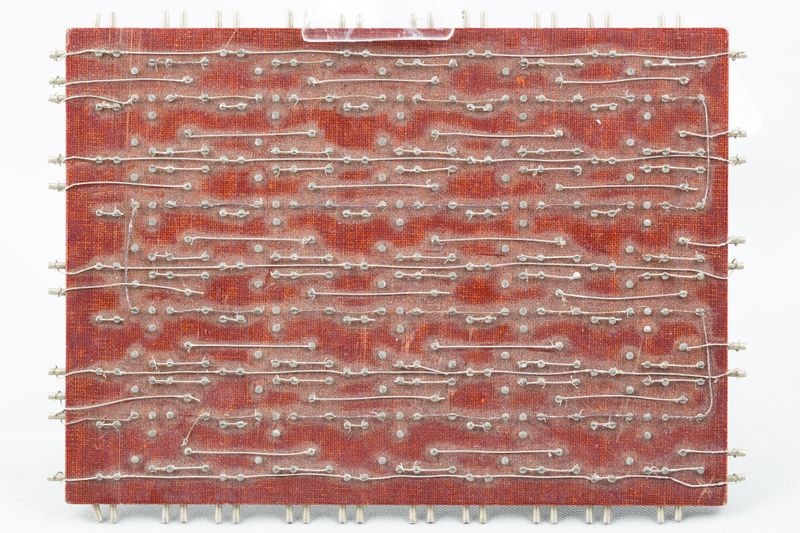
Wire-wound cryotron ring oscillator, 1954. From Albert Slade. Photo: Doug Fairbairn.
One of the very first of the engineers to be so inspired by Buck was Albert Slade. In the early 1950s, Slade was an electrical engineer working at the NSA. His job was to develop digital circuitry using the very new transistors coming out of Bell Labs. Buck, who was a consultant to the NSA, returned to his alma mater for a talk on his new work on the cryotron, and Slade was hooked. He became the point person on a new contract between the NSA and the research firm, Arthur D. Little, located adjacent to MIT. A.D. Little had unmatched technology in low temperature work and liquid helium, and it began a collaboration with Buck to develop cryotrons and superconducting digital circuits. Within a year though, Slade was eager to get into the cryotron work directly, leaving the NSA for A.D. Little and its cryotron effort.
One of Slade鈥檚 first efforts was to create a circuit for testing the performance of new forms of cryotrons, a 鈥渞ing oscillator.鈥� Some hundred of the wire-wound cryotrons were wired together into the ring oscillator on a single plate. Over time, Buck, Slade and the wider superconducting electronics community moved to cryotrons made of evaporated and then patterned thin films of tantalum and niobium. Slade devised a new kind of digital computer memory, an 鈥渁ssociative鈥� or 鈥渃ontent-addressed鈥� memory, and worked to fashion one out of a thin-film cryotron array: a superconducting integrated circuit. His program at A.D. Little became a central node of technology transfer, as it received regular funding and visits from the NSA, IBM, RCA, and GE. After creating a complete working memory system, and delivering it to the NSA around 1965, the A.D. Little program wound down, and Slade moved to Silicon Valley for a second career of entrepreneurship in electronics.
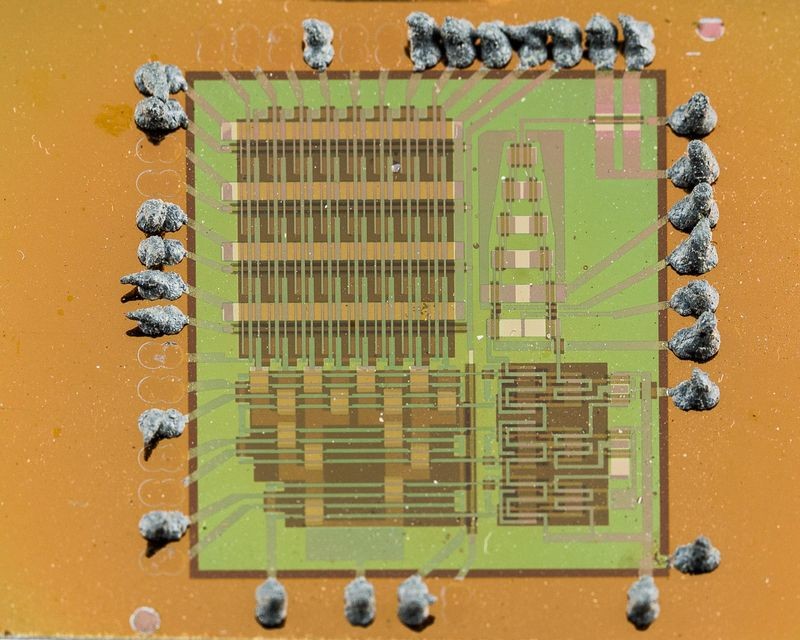
Thin-film cryotron, 4-bit memory IC. From Albert Slade. Photo: Doug Fairbairn.
Recently, Albert Slade donated several incredibly rare cryotron circuits to the 91自拍 from this earliest era of superconducting electronics: his ring oscillator of wire-wound cryotrons from 1954, his thin-film cryotron memory integrated circuit from 1965, and two examples of similar cryotron integrated circuits from RCA of the mid 1960s.
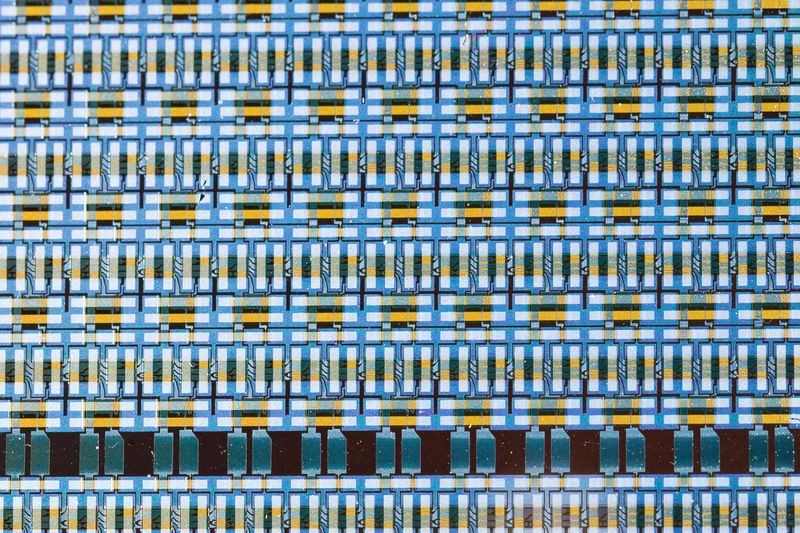
Close-up of RCA thin-film cryotron, ca. 1965. From Albert Slade. Photo: Doug Fairbairn.
While Buck died tragically early, and Slade moved on to other pursuits, cryotron electronics never completely faded away. A new form of cryotron-like device, initially called a 鈥渢unneling cryotron鈥� but today known as a 鈥淛osephson Junction鈥� became a subject of intense interest in the 1970s. IBM spent millions into the early 1980s in an attempt to build a supercomputer with them. More recently, Josephson Junctions have become a focus of attention in the quest to build quantum computers and superconducting supercomputers.
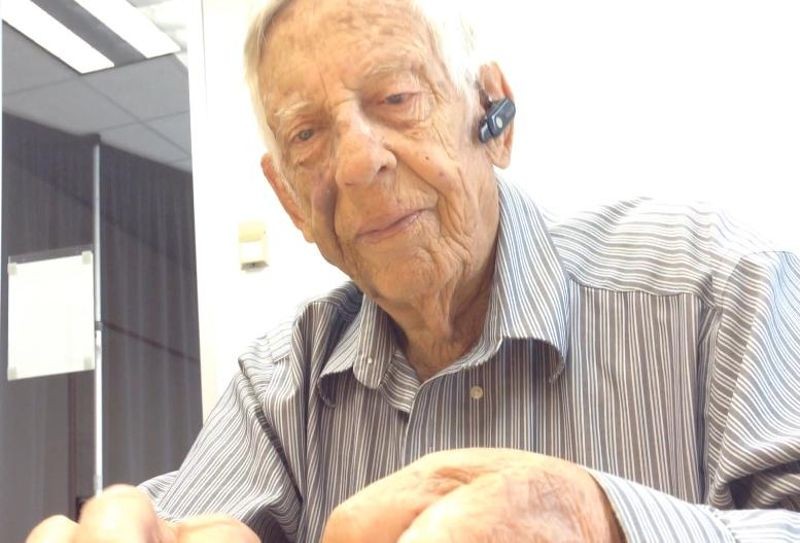
Albert Slade visiting 91自拍 June 25, 2014.