


Editor's Note: This is part of an ongoing series dedicated to the web anniversaries of 2019, including the 50th anniversary of general purpose computer networks connected over the ARPANET, the 30th anniversary of the web鈥檚 conception, and shorter anniversaries for everything from mass Wi-Fi to familiar giants like Amazon and Facebook.
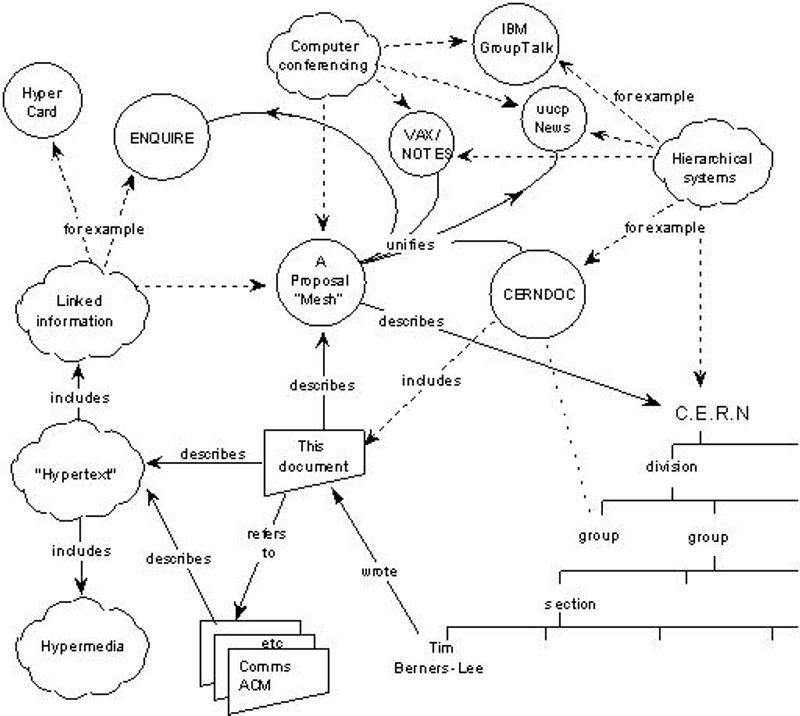
Diagram from 鈥淚nformation Management: A Proposal鈥� By Tim Berners-Lee, CERN, 1989. 漏 CERN
Thirty years ago this month, physicist turned programmer Tim Berners-Lee first proposed what became the World Wide Web. A few months later he resubmitted the proposal with his colleague Robert Cailliau. Today the web is living up to its ambitious name, serving over four billion1 people with more to come. To mark the anniversary, we're reissuing an article that tells 2 the story of how the infant web beat out bigger, better funded rivals to bring the online world to the rest of us.
Since the 25th anniversary in 2014, problems from 鈥渇ake news鈥� to wholesale harvesting of personal data have exposed some of ironies of the web's evolution: a system designed to be decentralized and open has also given rise to enormous concentrations of power. But the story is far from over鈥攃heck back at the 40th and 50th for updates.
See below for a number of celebrations of the web at 30 happening around the world:
March 12, 2019
May 13鈥�17, 2019
Other important web milestones coming up include the first demo browser, server, and web site (December 1990), and the public release of the WWW code library so that hackers anywhere could build their own browsers and servers (August 1991).
A team at CERN has restored the first 1990 web browser, which was also an editor and represented the original vision of what the web would be:

Sir Tim Berners-Lee, ca. 1999. 漏 Andrew Brusso/Corbis

Robert Cailliau, 1995-06. 漏 CERN Geneva
2019 is a year of many web and networking anniversaries, or 鈥渘etiversaries鈥� to coin an awful word. On the web side, it has been 25 years since the popular explosion and the rise of web commerce, including the launch of Netscape, Amazon, Yahoo!, and many others. It has also been 25 since the so-called 鈥淲oodstock of the Web,鈥� the vastly oversubscribed first web conference in 1994. The series is still going strong, with coming in May to San Francisco.
Twenty years ago Japan rolled out the mobile web the rest of us wouldn鈥檛 discover until the iPhone era (i-Mode), while here we remember 1999 for Napster as well as the teetering height of the dot-com boom. Lastly, 2019 marks 15 years since the web鈥檚 popular rehabilitation following the crash, including Google鈥檚 IPO and the rise of 鈥淲eb 2.0鈥� sites like Yelp, Flickr, and a social network called Facebook.
10 years ago marks the start of yet another try at a digital crypo-currency in the mold of the pioneering 1989 Digicash Inc. The upstart was called Bitcoin.
Our upcoming yearly Core magazine and future articles will explore other 鈥渘etiversaries鈥� of 2019, including the 50th anniversary of general purpose computer networks. That first connection was over the ARPANET, between Douglas Engelbart鈥檚 laboratory at SRI and another node at UCLA. Such networks were built as transport for online systems like Engelbart鈥檚 oNLine System, famously demo'ed in late 1968, which is a key ancestor of the web. Another blog article in @91自拍 remembers Engelbart and his work.
For exhibits on the evolution of the web and the online world, visit the , , and galleries of our exhibition Revolution: The First 2000 Years of Computing, either or .
For the story of the web's conception and birth, see this article from the 25th anniversary.