


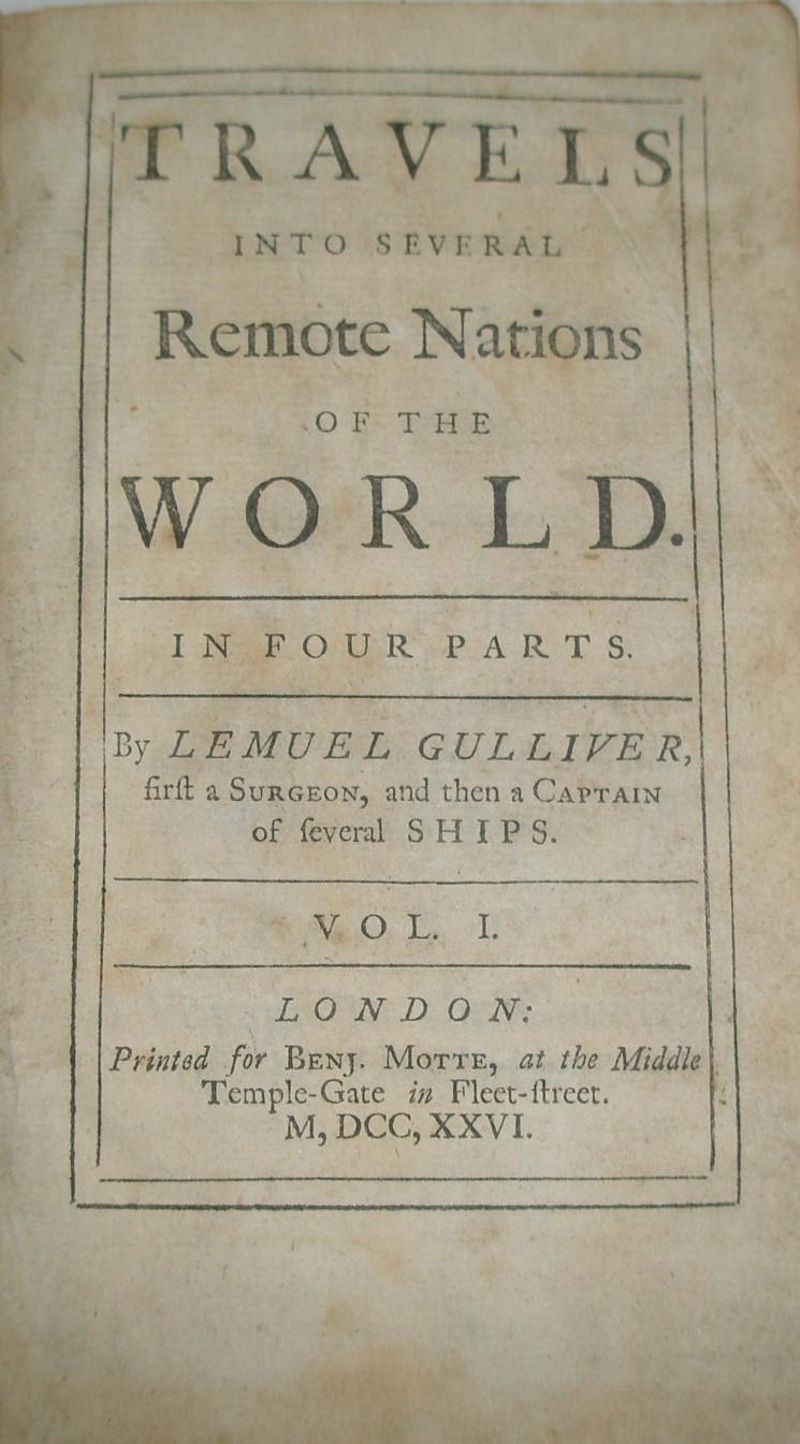
Title Page from the First Edition of Gulliver鈥檚 Travels
Sometimes, we can look back at fictional items from the days before the computer and see threads to machines that would exist decades, or even centuries later. When the museum opened , a visitor pointed out that we didn鈥檛 mention what they considered to be the earliest description of a computer鈥搘hich he said had been described in the book Gulliver鈥檚 Travels. After a bit of research and a lot of reading, it appeared that while it might not have been a description of a computer, this piece of fiction did hold some very interesting ties to the modern field of computation.
Travels into Several Remote Nations of the World, in Four Parts. By Lemuel Gulliver, First a Surgeon, and then a Captain of Several Ships, better known as Gulliver鈥檚 Travels, is one of the most successful novels ever written in the English language. The story of Lemuel Gulliver as he travels through strange nations and meets their bizarre inhabitants has thrilled readers since it was first released in 1726. Author Jonathan Swift was the most celebrated English novelist of his day. Born in 1667, Swift was a poet and preacher who wrote several satirical novels about religion, history and the sciences. Gulliver鈥檚 Travels is often pointed to as his masterpiece and has been in print since its first release, almost 300 years ago! In the story, Gulliver encounters the strange and wonderful peoples of the world during a time when great discoveries were regularly being made by explorers and inventors.
At one point in the story, Gulliver encounters a fascinating machine while visiting the Academy of Projectors in the land of Lagando. Gulliver describes the machine, called The Engine:
This is one of the earliest known mention of a machine that could be considered as a computer in literature, more than a hundred years prior to the first calculating engine designs by Charles Babbage. The Engine might be seen as a computer, but perhaps it鈥檚 better thought of as a sort of random-number generator. The machine would create prose and poetry, entirely mechanically. The method of its operation involved turning the frame on which all the words of the language hung and having students read them aloud while capturing the results. Swift described its operation as such:
As long as there have been computers, artists and hobbyists have tried to use computers as engines of creation. Like the Engine from Gulliver鈥檚 Travels, many experiments have been made to see if computers could be used to create and tell stories. One early example was done at MIT during their 100th Anniversary in 1961. MIT鈥檚 computer scientists fed a series of rules into their TX-0 computer. They choose to program the rules of a scene from a Western featuring a robber and a sheriff. Using the rules supplied to the computer, actors played the scene exactly as the computer composed it, even when the machine ended up in a loop.
In the world of the visual arts, perhaps no system is more famous than AARON, created by artist/computer scientist Harold Cohen. AARON would create paintings based on a system of rules and AARON would paint it. This, of course, led to questions of who was the artist actually creating the art: Cohen or AARON?
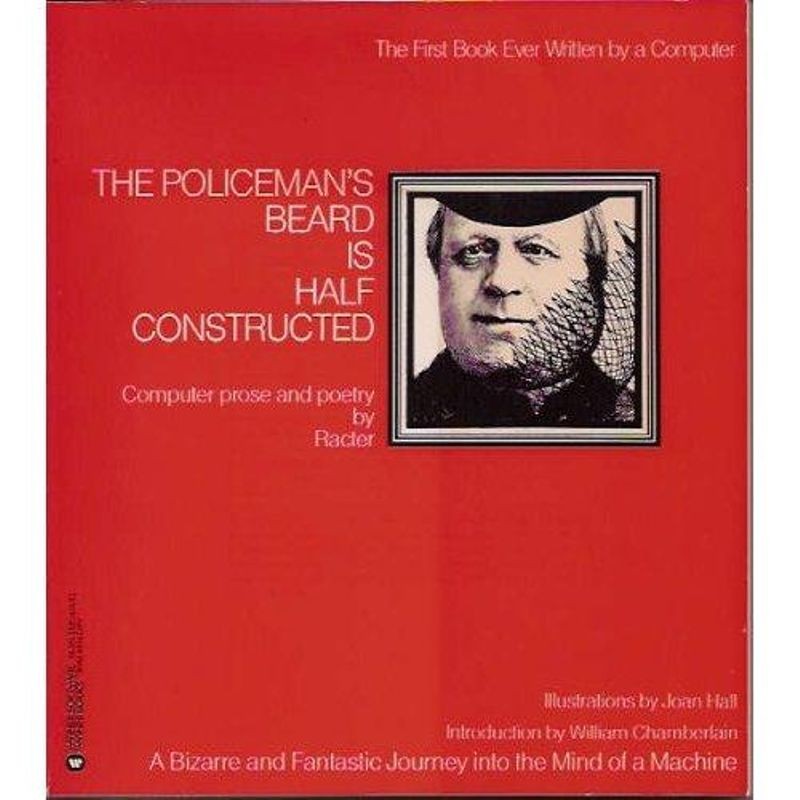
Cover to The Policeman鈥檚 Beard is Half-Constructed
The program that could be seen as most similar to The Engine is Racter, a microprocessor-based program that could be used to randomly generate English poetry and prose. The original version of Racter was used to write a book of short prose and poetry called The Policeman鈥檚 Beard is Half Constructed. The creators claimed that it was the first book ever written by a computer. Some of the poetry was brief, such as 鈥淪lice a visage to create a visage. A puzzle to its owner,鈥� while some of the prose stories ran for several pages. Like the Engine, Racter鈥檚 works were heavily edited down from a large amount of material, leading many to compare it to the theoretical 鈥淢onkeys with typewriters鈥� concept. While many of these pieces made little sense to the casual reader, they showed that a computer could be used to automatically create works of art. Other software programs have been written to create prose and poetry and several books have since been released, thought none with the impact of Racter.
Looking at the Engine does show that even before we had computers, we had people considering the automation of creative processes using machines. Perhaps we should not have been surprised that computers found such great use in the arts: people have been thinking about it for 300 years!